
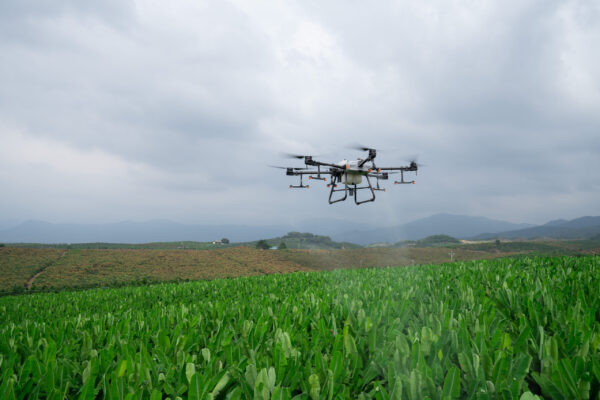
New bill will allow drone spraying in agriculture
Soon in Bulgaria it will be possible to use drones for spraying pesticides and fertilizers in agriculture. This provides for a bill to amend the Plant Protection Act. Bulgaria is at the forefront of countries where such a law will be adopted. The bill aims to align Bulgarian legislation with European regulations that regulate the requirements for placing on the market and production of plant protection products and fertilizing products. Also, the project addresses the issue of using unmanned aerial vehicles (drones) for agricultural activities related to plant protection and the use of plant protection products through these new technologies. Part of the conditions for permitted drone spraying will be: Certificate of conformity issued; Shade temperature lower than or equal to 25° C; Wind speed from 1 to 5 m/s; Air humidity higher than 50 percent, etc. The height from which plant protection products are spread is many times smaller in the case of the drone, than in the case of aerial spraying, which is carried out by plane or helicopter. This, in turn, significantly reduces the drift of the drone jet, respectively reduces both the amount of plant protection products needed to achieve an optimal result, and also the possibility of pesticides falling outside the areas designated for treatment, i.e. in bordering territories, water basins, forests, etc. Using drones to spray pesticides and fertilizers will have a number of benefits for farmers and the environment. Drones will allow for more precise and efficient application of preparations, which will lead to a reduction in costs, an increase in yields and preservation of soil fertility. Drones will also help reduce the effects of pesticide use on human and animal health, as well as reduce water and air pollution. The draft law to amend and supplement the Plant Protection Act is open for public discussion until March 15, 2024. All interested parties can express their opinion and give their suggestions on the draft law. Motives The proposed regulatory changes are aimed at solving a major problem related to the possibility of using unmanned aerial vehicles (drones) for activities in agriculture related to plant protection and the use of plant protection preparations through the use of these new technologies. The Plant Protection Act (PPA) regulates two types of spraying – aerial and ground. Unmanned aerial vehicles (drones) cannot be assigned to either of these two types, which creates a gap in the existing legal framework regarding the use of plant protection products. Through these new technologies, a reduction of the harmful consequences of the use of pesticides is ensured and an opportunity to develop the so-called precision agriculture is provided, the ultimate goal of which is the use of the most sparing methods and technologies, allowing the achievement of plant protection goals and at the same time reducing the quantities of pesticides used, respectively their harmful effects. The goals that the EU sets within the framework of the Green Deal are related to promoting precision agriculture and reducing the amount of plant protection products used. The use of drones to spray pesticides ensures that these goals are achieved. This is due to the extremely precise technology that is used for the purpose. A study carried out in late 2021 and funded by the European Commission, related to the evaluation of Directive 2009/128/EC and its possible revision, concluded that no derogation would be necessary for drone spraying, as well as any other kind spraying if the spraying tool is no more than 2 meters from the plant being treated. Unlike aerial spraying, for which European legislation has introduced a ban and left it to Member States to define the procedures for allowing exceptions to this ban, drone spraying has a number of advantages, namely: The height from which plant protection products are sprayed is many times smaller with a drone than with aerial spraying, which is carried out by airplane or helicopter. This, in turn, significantly reduces the drift of the drone jet, respectively reduces both the amount of plant protection products needed to achieve an optimal result, and also the possibility of pesticides falling outside the areas designated for treatment, i.e. in bordering territories, water basins, forests, etc. The technical characteristics and capabilities of drones intended for use in agriculture allow the treatment of only part of the plants (e.g. infected outbreaks), which helps to limit the areas on which pesticides are used and the rapid limitation of plant infections. Compared to ground spraying, which is carried out up to about 1.5 meters above the plants, and when treating orchards sometimes up to 7 meters high, drone spraying allows optimal treatment of the plants from a distance of 2 meters above the treated plants, practically leveling them with spraying by ground agricultural equipment, but at the same time the pressure that the drone provides allows for a much more efficient spraying of all parts of the plant, including the lowest, and using smaller amounts of plant protection products, making the treatment with a drone many times more efficient and at the same time more sparing not only than aerial spraying, but also the ground one. The advantages of using a drone to process plants and plant protection products are even more tangible when spraying fruit trees. In these crops, the ground spraying directs the jet upwards and in order to maximally treat all parts of the crown of the tree, it is necessary to create a much stronger jet, respectively the use of a larger amount of pesticides, which is very effectively avoided when using a drone. This is because of the precise technology used in the drones, such as the ability to recognize the crowns, allowing the jet to be precisely directed, hovering directly over the plants / trees, creating pressure that directs the jet where it is needed, namely into the crowns of the trees, limiting the unnecessary spreading of pesticides affecting neighboring territories. Other advantages of spraying with a drone derive from the technical capabilities of the implemented technological…